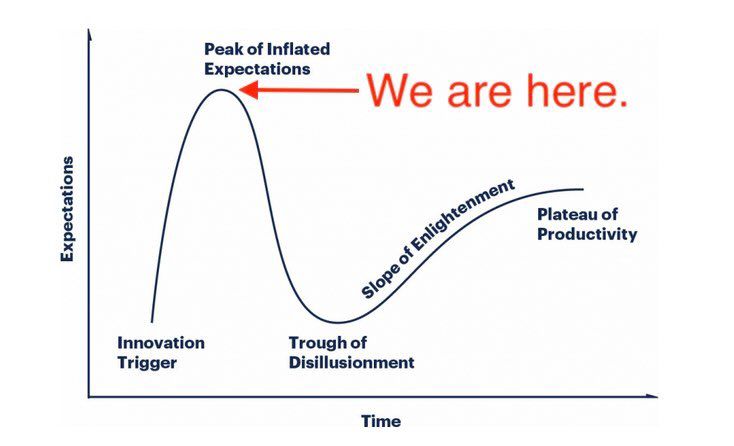
Has Generative AI Reached Its Peak in Gartner's Hype Cycle?

Artificial Intelligence

The Fourth Industrial Revolution

Sam Mendoza's profile picture on Select App
SM

Sam Mendoza

·3 years ago
shared a poll post in group #Artificial Intelligence
Has AI reached the the "Peak of Inflated Expectations" in its Hype Cycle? Gartner, who's Hype Cycle tracks the maturity of various technologies throughout their lifecycles. The cycle involves five stages: Technology Trigger, Peak of Inflated Expectations, Trough of Disillusionment, Slope of Enlightenment, and Plateau of Productivity. - Gartner added generative AI to its Hype Cycle for Emerging Technologies for 2023, forecasting "transformational benefit" in the next 2 to 5 years. - As per the cycle, current expectations for generative AI are at their peak, but they could soon drop off as excitement fades and it enters the Trough of Disillusionment. - Gartner believes generative AI will reach the Plateau of Productivity in the next two to five years. - Other tech expected to reach productivity in that time include AI-augmented, causal AI, and others.
 
avatar

Bobby

But About That #Artificial Intelligence Bubble… I cannot remember the last time I had a lengthy conversation with anyone important in tech that didn’t involve AI. It’s the industry’s preeminent preoccupation. Yet Pew Research is out with some eyebrow-raising poll results. In a survey of white-collar Americans, more than half said they rarely or never use an AI chatbot at work and just 9% said they use one daily. Nearly a third of the respondents said they had never even heard of a chatbot. Both of those figures astounded me and left me puzzling on what Pew’s study suggests: It may be a marker that AI has an enormous market still to conquer. It could just as easily be a warning sign that Silicon Valley has vastly overestimated how much America wants AI. Or needs it. pewresearch.org/social-tr.. #Data is beautiful
3. Workers’ experience with AI chatbots in their jobs

www.pewresearch.org

3. Workers’ experience with AI chatbots in their jobs

A majority of workers rarely or never use AI chatbots like ChatGPT, Gemini or Copilot at work.

 
avatar

Jerome Cody

[PREDICTION 2026] The #Artificial Intelligence bubble talk that dominated tech discourse in 2025 will continue all year long. We shouldn’t be surprised if there are some spectacular flameouts next year, particularly if models from the frontier labs improve enough that businesses can deploy them directly and not pay $50 per user per seat per month for some AI startup’s product. And some public companies will undoubtedly lose tens of billions of dollars trying to catch up to the leaders. (The odds of Meta catching up are long, and growing longer.) But I predict that 2026 ends more or less as 2025 did, with OpenAI, Google, Anthropic, and mayyyyybe xAI jockeying for prime position. As the analyst Benedict Evans recently wrote: “The fact that AI is working really, really well, and has no signs of hitting a wall, and will change the world… Does NOT mean that there cannot also be a bubble in AI. In fact, that’s generally the kind of thing that *causes* bubbles.” If you want to prepare yourself for 2026, internalize that point. #Data is beautiful #The Most Important Thing


Tasia

AI is not the next dot‑com bubble, and I’m willing to die on that hill. It does have all the hallmarks of a bubble: there’s a huge amount of capital, and inflated expectations that lasted years (and in some cases, still do). I’m sure there’s a long tail of companies that won't even make it. That part is familiar. But the resemblance stops there. What I’m seeing day to day feels different: non-technical founders are writing code, and teams are getting smaller and moving faster. That doesn’t mean you can replace an engineer or an analyst just because you can write code and SQL queries now. You still need people, but the nature of the work is shifting. What used to take up most of their week now happens automatically, or nearly so. The actual work has moved upstream, from doing the thing to deciding which thing matters (and what to do with the result). That does mean some skills are becoming obsolete, and that’s unsettling. But it’s also because AI is so different from the technologies that came before it. Most past technologies extended human capacity: electricity powered machines and computers processed data. In all of those waves, human judgment remained the bottleneck. AI is different. It performs parts of the cognitive work itself, and gets better the more it’s used. So the new constraint is not how much intelligence you can hire, but how well you can direct the intelligence you already have access to. That’s the actual shift. And while people debate whether this is a bubble, the more interesting question is: what becomes possible when intelligence is no longer scarce? So what are you building now that isn’t?

 
avatar

Todd Smith

Possibly the only thing more boneheaded than Allbirds’ pivot into AI was Wednesday’s investor reaction. It makes you think that if a shoemaker can do so well jumping into a highly technical, competitive arena it knows nothing about, why aren’t other apparel makers or even food companies following suit? It’s not clear whose idea this was, or whether anyone from Allbirds’ management and board will stick around to see it through. Allbirds, of course, announced a couple of weeks ago it was selling its money-losing shoe business to a fashion brand for just $39 million. The company could have just distributed to shareholders whatever money was left after payments of debts and other liabilities and called it a day.  But no. Allbirds’ management knows a hot trend when they see one, even if power-hungry AI chips are a massive departure from the environmentally friendly approach to shoes the company championed. It is raising up to $50 million in a convertible note offering to fund the AI chip diversification. A bunch of other companies, mostly crypto miners such as CoreWeave, Crusoe and TeraWulf, have already jumped into AI chip rental (the neocloud business). Still, pivoting from crypto mining to AI isn’t crazy, given that both industries involve running servers doing intense computation (not that it’s an easy change of direction. Allbirds, though, is a whole different story. Neither the management nor the board has experience in AI chips, as far as we can tell from their online bios.  Perhaps the board sees this transformation as a way to wring more money out of the public listing. Maybe the idea is to build up a bit of a business and then sell to an existing player. That might work. bloomberg.com/opinion/new..
AIbirds

www.bloomberg.com

AIbirds

NewBird AI, an Avis Budget squeeze, sports factor models and recursive online courses.

 
avatar

Cyril

Tasia
AI is not the next dot‑com bubble, and I...
@Tasia You made an economic claim and provided zero economic reasoning for your claim. The dot-com bubble didnt burst because the technology was bad - it was because it was way oversold to people who had no idea what they were doing, convincing investors, politicians and normal people to give their money and attention without ever proving ROI or cost/benefit. That is where AI is right now, except about 100x the scale. Imagine what happens next.

Embed post to a webpage :
<div data-postid="ewykyrz" [...] </div>
Powered bySelect·iOS·Android
Privacy|Terms|